The Difference Between EPS Emergency Power Supply and UPS Uninterruptible Power Supply
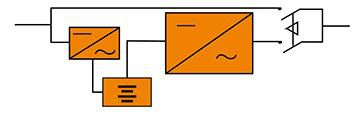
EPS emergency power supply | UPS uninterruptible power supply | |
Principle |
DC-AC inverter power supply in emergency |
Uninterrupted AC-DC-AC inverter power supply |
Structure | 1 The inverter has a large amount of redundancy and requires normal operation under 120% load 2 The incoming and outgoing cabinets are inside the emergency power supply 3 The motor load has variable frequency start 4 can be linked with fire 5 The casing and wires have flame retardant measures, and there are multiple mutual investment functions. 6 There are special measures such as moisture-proof, mildew-proof and rodent-proof | 1 The inverter redundancy is small, and it will shut down in 1 minute under 120% load 2 There are no incoming and outgoing cabinets in the machine 3 No need to start with frequency conversion 4 Not related to firefighting 5 No flame retardant measures, no mutual investment function 6 No special measures |
Other | 1 Target load: inductive, resistive load 2 Service objects: motors, pumps, fans, lighting 3 main features: strong adaptability to load 4 Purpose of work: to ensure that emergency power supply is foolproof 5 Place of use: placed in the building shaft or distribution room EPS emergency power supply is a fire protection product, which is a special fire emergency lighting power supply for centralized emergency power supply. | 1 Target load: capacitive load 2 Service object: computer class 3 main features: adapt to a single load 4 Purpose of work: to ensure uninterrupted and stable power supply 5 Use location: placed in the data center, computer network room The EPS uninterruptible power supply is a non-fire-fighting product, and it cannot pass the fire-fighting acceptance when it is used for fire-fighting emergency lighting. |
Advantage Comparison | ||
power saving | In the sleep state when the power grid is normal, the power consumption is less than 0.1%; when there is no grid power supply, its efficiency is more than 90% | It also works when the power grid is normal, its efficiency is only 80~90%, and about 10~20% of the power is consumed |
Nose | When the grid power supply is normal, it is in sleep state, and there is no noise at rest. When there is no grid power supply, its noise is less than 55dB | UPS working noise is generally 55dB~65dB |
Price | Low prices for EPS hosts | The price of the UPS host is relatively expensive |
Shelf life | The inverter work is only performed when the power grid is out of power. The service life of the host is relatively long, generally more than 20 years. | UPS works continuously and uninterrupted as long as it is turned on, so its lifespan is relatively short, usually 5 to 8 years. |
Load adaptability | Especially suitable for inductive loads such as motors and various mixed electrical loads | UPS adapts to capacitive and resistive loads (for data centers and network computer rooms) |