

4G Network Standard: Introduction and Technical Differences of TD-LTE and FDD-LTE (2)
The Difference Between TD-LTE and FDD-LTE Technology
TD-LTE is LTE with time division multiple access, and FDD-LTE is LTE with frequency division multiple access. Simply put, time division means that different users occupy different times, and frequency division means that different users occupy different frequencies.
Frequency Division Duplex (FDD) and Time Division Duplex (TDD) are two different duplex methods. FDD is to receive and transmit on two separate symmetrical frequency channels, and use guard bands to separate the receive and transmit channels. FDD must use paired frequencies to distinguish uplink and downlink by frequency. When FDD supports symmetric services, it can make full use of the upstream and downstream spectrum, but when it supports asymmetric services, the spectrum utilization rate will be greatly reduced.
The difference between the working principles of the two
TDD uses time to separate the receive and transmit channels. In a TDD mobile communication system, receiving and transmitting use different time slots of the same frequency carrier as the bearer of the channel, the resources in one direction are discontinuous in time, and the time resources are allocated in two directions. In a certain period of time, the base station sends a signal to the mobile station, and at another time, the mobile station sends a signal to the base station. The base station and the mobile station must be coordinated to work smoothly.
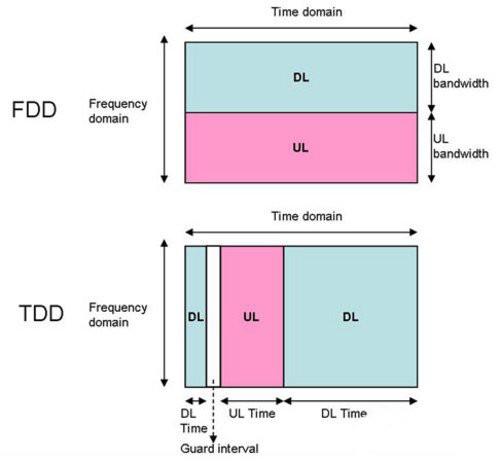
As can be seen from the above figure, the horizontal axis is the time axis, and the vertical axis is the frequency axis. DL stands for downlink data, and UL stands for uplink data. In the FDD mode, the uplink data and the downlink data are on the same symmetrical frequency and need to be transmitted at the same time. The advantage is that the frequency width is large and the data transmission speed is fast. However, if you encounter asymmetric services, such as downloading things, the downlink data will be much larger than the uplink, so the frequency channel of the uplink data will be occupied. In the TDD mode, the uplink and downlink data do not need to be transmitted together at the same time, so it can be dynamically allocated according to the size of the uplink and downlink data, which is better for the utilization of frequency channels.


